
two smiling women sitting at a table working on laptops together

Help! I Have Multiple Audiences

Skills That Deliver Results

Tag: website content

  • Help! I Have Multiple Audiences

    Help! I Have Multiple Audiences

    “Who are you talking to?”
    “What do you want to say?”

    Those are the first two questions I ask any person, any business, no matter what they’re working on. Whether it is a website, social media, newsletter, brand voice, ads — it doesn’t matter. Everything boils down to those two questions. Who are you talking to? What do you want to say?

    And if those are the two most important questions, then they should be easy to answer, right?

    Nope.

    More often than not, the first word I hear is:
    “Well…”

    Well, it depends.
    Well, we have multiple audiences.
    Well, well, well.

    It’s one of the most common challenges I see businesses run into when communicating. And suddenly, my job shifts from helping them tell their story to helping them figure out who they’re even talking to.

    The Problem With Multiple Audiences

    Here’s the thing: When you try to speak to everyone, you end up speaking to no one. 

    Too often, I see businesses confuse their audience right from the start by saying too much in too many different ways. You’re trying to cover every possible need, answer every possible question, and make sure every type of person knows they’re welcome. I get it, but if you’re not careful, you’ll end up with a message that is vague, bloated, and forgettable. Aka, every marketer’s worst nightmare.

    Prioritizing the RIGHT Audience

    Some audiences need more handholding than others. That’s not a bad thing. Actually, it makes our jobs a lot easier. If you’re trying to speak to multiple audiences, you have to prioritize the one that is the neediest.

    Recently, I was helping an architecture firm with a brand voice workshop and new messaging guide. They had two main audiences: homeowners and contractors. Totally different audiences with different messaging and different asks, right? Homeowners need design inspiration and emotional reassurance. Contractors need logistics and technical clarity.

    Not quite.

    I helped them realize that contractors don’t need to be sold. They just want to know that you’re legit. Are you professional? Have you done this before? Can you keep a project moving?

    Homeowners, on the other hand, do need to be sold. They’re the ones trusting this firm with their dream homes. They’re the ones pouring over Pinterest boards, saving photos of archways and kitchen islands. When you frame it that way, the answer becomes obvious: speak to the homeowners.

    Another Example

    Nonprofits. Every nonprofit I have worked with has two key audiences: the people they serve and the people who donate. So, who gets the priority in messaging?

    Without a doubt: Donors. Every time.

    The people you serve already understand your mission — they’re living it. Donors, on the other hand, need to be convinced. They need to feel something. They need to believe in your cause, trust your leadership, and know their money is going to good use. That takes handholding. That takes a story.

    But What About the Other Audiences?

    I’m not saying ignore them. They just don’t need to be the focus.

    Instead, the second audience (or third, or fourth) just needs to know you are who you say you are — and that you’re worth trusting. Often, when you’re speaking clearly and confidently to your primary audience, the others will pick up on those cues. 

    They’ll see the testimonials.
    They’ll read between the lines.
    They’ll know you’re the real deal.

    Making Room for Exceptions

    I’m a big fan of the idea that sometimes, you have to break the rules. (But only when you really understand the rules, can you break them well.)

    There are absolutely going to be exceptions. You don’t have to force every message into one audience’s mold. The goal is to keep your messaging streamlined, but sometimes it makes sense to segment or customize. 

    When you’re trying to decide if it’s time to break the rules, ask yourself:
    Will it muddy the message for my core audience?

    If the answer is yes, it may be time to separate things out. 

    Here are a few ways to do that without overcomplicating your message.

    Clear Sitemaps

    A sitemap isn’t the place to get cute. It needs to be crystal clear, especially if you’re working with multiple audiences. 

    For example, if you’re an architecture firm that works with multiple audiences, include a “Projects” tab in your main navigation with drop downs for “Commercial” and “Residential.” That way, everyone can easily select the page that’s speaking directly to them. Just make sure your homepage and pillar pages still focus on your primary audience — those homeowners who need a little extra love.

    Email Segmentation

    Sometimes, your message is meant for the secondary audience. That’s what email segmentation is for.

    Back to the nonprofit example: maybe you’re opening enrollment for a new program. Your donors don’t need that email. If anything, it may confuse them. That message should go to the people you serve, not the people funding the work. Keep the stories and appeals separate so each audience gets the clarity they need.

    Tailored Materials

    I see it a lot: two websites, two social media accounts, two different stories. That’s often not necessary, and it always dilutes your message. What you can do is create different one-pages, PDFs, social posts, and A/B tests. Use the same voice and brand identity, but shift the focus.

    Need to reassure contractors? Show them your process, timeline, and past collaborations.
    Need to reassure homeowners: Lead with emotion, creativity, and impact.

    The Most Important Rule for Multiple Audiences

    When you’re speaking to multiple audiences, start with the one who needs you most. The one who’s confused, hesitant, nervous. The one who’s holding a dream in one hand and a dozen open tabs in the other.

    Speak to them.

    Everyone else will keep up.

    Need help figuring out who you’re talking to — and how to talk to them?
    Let’s work together. I’d love to help you find your voice.

  • JH Berry: Website Copy as Branding

    JH Berry: Website Copy as Branding

    screen recording of JH Berry's hero section of their website. Website copy says "Commercial Real Estate Is Complex. We Simplify It." over a drove video of Birmingham's skyline.

    The Ask

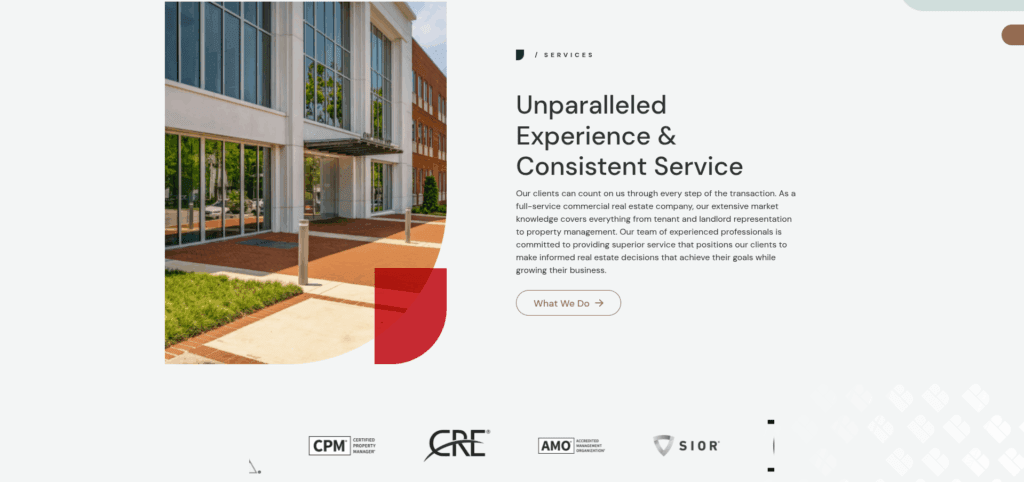
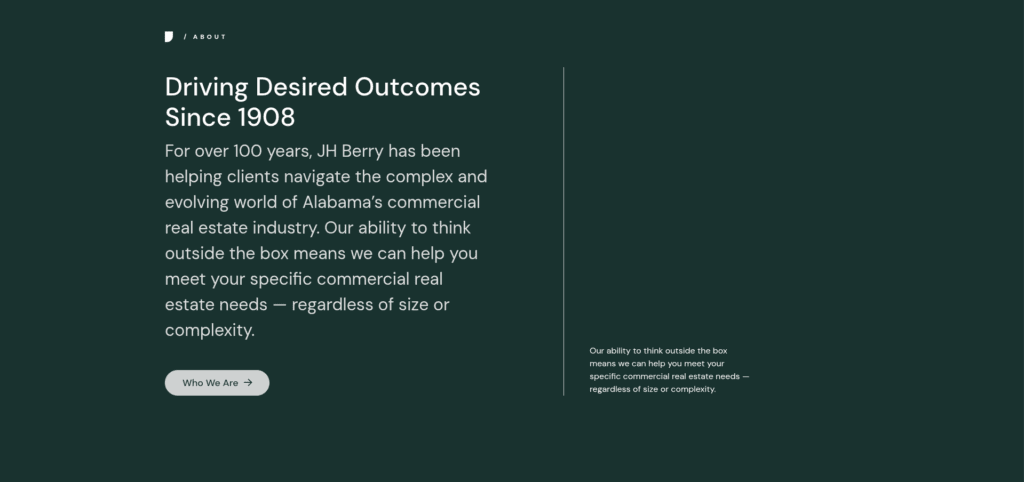
    JH Berry needed their website copy to communicate exactly what they do — and fast. They wanted visitors to immediately understand that they help businesses lease, buy, and sell commercial real estate. On top of that, the site had to build trust. With over a century in the industry, their team had the experience — but their existing branding didn’t reflect it.

    The Result

    I delivered content that quickly communicates their services and long-standing expertise, with website copy that projects confidence without ego. The new tone says: we’ve been doing this for over 100 years, and we’re still evolving. The result is what the team called a “big-tique” brand feel — boutique service with big-market credibility.

    Why It Worked

    From headers to CTAs, the messaging is purposeful. By centering the benefits of their services and weaving in subtle nods to their legacy, I was able to position JH Berry as both experienced and forward thinking. The site builds immediate trust with visitors by answering the who, what, and why without making them dig — a strategy that aligns with how modern B2B audiences browse and make decisions. Paired with sharp design and intuitive navigation, the website copy helped bring their brand into the present without losing what made it meaningful in the first place.

  • Case Study: Brand Voice Workshop and Guide

    Case Study: Brand Voice Workshop and Guide

    The Ask

    One of the first things I do when meeting with new clients is ask a handful of basic questions to inform their content strategy. Things like:

    • Who is your audience?
    • What do you do?
    • What makes you different from your competitors?

    More often than not, I was met with long pauses, inconsistent answers, or complete uncertainty. Without clarity, the entire content phase struggled  — from strategy to execution. 

    I needed a way to get every project on track from day one. Bonus points if I could give teams the tools to stay aligned long after their website launched.

    The Results

    I created a fully interactive brand voice workshop. The deliverable was a practical, easy-to-use guide that helps teams stay on message, no matter who is behind the keyboard. 

    The final guide gives them something they’ve (usually) never had before: a clear, consistent way to talk about who they are, what they do, and why it matters. All of this is tailored to their specific audience and packaged in a way that they can actually use. In short, it makes it easy to speak with clarity and confidence, whether it is a freelancer, a new hire, or a seasoned staff member.

    Why It Worked

    Start With What You Know

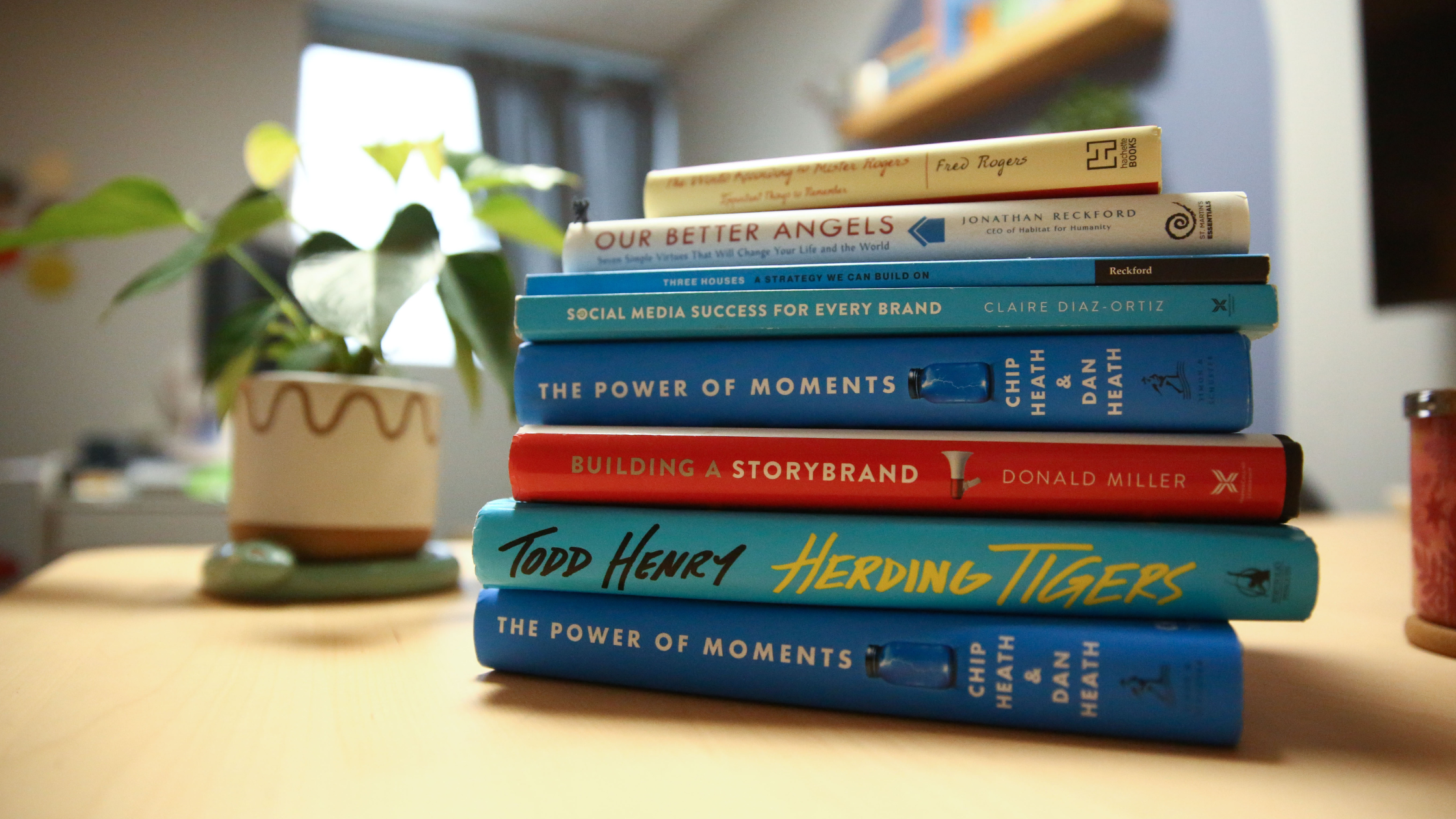
    I have nearly a decade of experience creating strategies and writing copy for business, so I started with the questions I ask during the discovery phase. But I knew that wasn’t enough to fully encapsulate everything this Brand Voice Guide needed to be. I leaned into my love of learning new things and read everything I could get my hands on about brand storytelling.

    My reading list included:

    Brand Voice Has Multiple Applications

    I knew this guide couldn’t just be for the website, because the website is only one piece of the brand. If the website content says one thing and everything else says something else, it isn’t serving the business or the audience. That’s why we started with high-level positioning that could be applied anywhere: website copy, social posts, blog, newsletters, scripts, sales emails, onboarding, and more.

    Once your voice is defined, every message gets stronger — and easier to write. 

    Lessons Learned

    Brand Voice Is More Than StoryBrand

    A lot of businesses put all of their eggs in the StoryBrand basket. Don’t get me wrong, StoryBrand is great for what it is, especially if you’re starting from zero and looking for a DIY option. I’m not saying StoryBrand doesn’t work. I’m saying it isn’t enough. It’s too black and white. It lacks nuance and context.

    With this workshop and guide, I wanted to look at the business as a whole, its long-term goals, and how messaging can grow with it. The result is deeper, more flexible, and better suited to real-life content creation.

  • Website Mistakes You Don’t Know You’re Making | Part 2

    Website Mistakes You Don’t Know You’re Making | Part 2

    Even with the best intentions, common mistakes can creep in and weaken your message, damage your credibility, or even impact your search rankings. The good news? Most of them have simple enough fixes. Let’s dive into a few of the biggest website mistakes and how to avoid them. 

    Inconsistent Voice

    If you don’t have a defined brand voice, your website may be missing the mark. This disconnect often happens when different departments write their own pages. Or even when older pages were written by a different person than the more recent ones. It may not seem like a big deal. No one reads your website like a novel, after all. BUT (of course, there’s a but), a consistent brand voice is the key to building trust and credibility with your audience. When visitors click through your site, you want them to have a consistent and engaging experience. Essentially, you want your website to sound like you — authentic and unmistakably yours!

    The Solution?

    The solution is a two-step process. First, you need a defined brand voice. If you have multiple people writing for your brand, this is the only surefire way to ensure everyone is on the same page. Next, you need someone (or multiple someones) to use that brand voice guide to revise and refresh your existing website copy to match.

    Worrying Too Much About SEO

    That’s right, worrying too much about SEO is a big website mistake. I know what you’re thinking: “What do you mean? I want to rank at the top of search engine results.” Well, I didn’t say, “Don’t worry about SEO at all.” I just mean that you need to take a strategic, balanced approach to SEO.

    By now, we’ve all seen a website stuffed to the sitemap with SEO copy. Walls of text. Boring headers like “Website Copywriters in Birmingham, AL.” Buzzword overload. Keyword stuffing. While it may help you show up higher in search results (some research says it might do the opposite), what kind of user experience are you giving your users once they click on your site? Not a very good one. If you decide to write for crawlers, then you chose to NOT write for your audience. 

    The Solution?

    It’s a cliché — write it, and they will come. But it’s a cliché for a reason. When you write for your audience, maintain your brand voice, and use keywords where they’re natural, then you’re providing a good user experience. Google recognizes that and rewards you for it.

    Too Much (or Not Enough) Copy

    When I coach clients through writing their own website copy, one of the first questions is, “How much should I write?” No one likes the answer: it depends. 

    Writing website copy isn’t like writing a school paper — you’re not hitting a word count. You need to make it as long as it needs to be to tell your story and get your audience the information they need. However, I always err on the side of being more concise. Your website visitors aren’t there to read a novel. They want to quickly and easily find the information they want before moving on to the next thing. You only have a few seconds to grab their attention, so make it count. 

    On the other hand, that doesn’t mean you don’t need any copy. I hear many clients say, “People don’t read anyway.” Well, some don’t — you’re right there. But you know who does? Google. Know who else reads? Plenty of people! And why would you purposely leave out some potential customers or clients? Not to mention, having little to no website copy immediately makes it harder for people to trust you. If you don’t care enough about your business to take the time to write something down, why should they trust you?

    The Solution?

    Stick to best practices. They’re best practices for a reason, after all. When in doubt, hire a professional copywriter to help you get the job done. 

    Irregular Blogging

    Picture this: You need a landscaper, and you’re researching companies to pick the best one. You click through the About page to learn a little about the company. They sound legit. You check out their services pages. Yep, they offer the services you need. Then, you click on their blog page, and — wait, they haven’t posted anything in three years? Are they even still in business? Yikes. Guess it can’t hurt to keep searching.

    The Solution?

    The goal of a blog is usually to build trust and establish yourself as an industry expert. If you only post once every year, you’re likely doing the opposite. In a perfect world, the best solution is to blog regularly. Sit down, create a calendar, and stick to it. But we (unfortunately) don’t live in a perfect world. The next best thing is to remove the dates from your blogs. This shortcut might fool visitors, but it won’t fool Google. Realistically, if you can’t stick to blogging regularly, it may be best just to cut your blog altogether.

    What’s Next?

    If you’ve made it this far, chances are you’ve spotted at least one of these mistakes on your own website. So, what’s next? Grab a cup of coffee, pull up your site, and start taking notes. Identify what needs improvement, then create a strategy to fix it. Small changes can have a big impact. Your website is an investment — make sure it’s working as hard as it should be.

  • Rebel WITH a Cause: Copywriting Rules and When to Break Them

    Rebel WITH a Cause: Copywriting Rules and When to Break Them

    Early on in my career, a manager gave me feedback on my writing that caught me completely off guard.

    “It’s too perfect.”

    As a self-admitted perfectionist, this sent me into a spiral. What does too perfect even mean? How can writing be too perfect? Copywriting rules are copywriting rules — aren’t they?

    Well, maybe not. After some spiraling, some thinking, and a little more spiraling, I finally understood what my manager meant. Writing that follows every rule can feel rigid, robotic, and — ironically — less effective. Sometimes, you have to break the rules.

    Disclaimer: Rules are rules for a reason. There is a time and place to break them, which means there is absolutely a time and place to not break them.

    Rule: Avoid repetitiveness

    Break it: To emphasize a point

    If there’s a point you want to stick, say it again. And again. And again. There’s a reason the songs that get stuck in your head have repeating hooks and choruses — they make sure you don’t forget them. The same goes for copywriting. Repetition reinforces your message, builds momentum, and makes your words more memorable. It’s not about adding fluff; it’s about adding focus. When you repeat key ideas, you guide your audience to what matters most — and make sure it sticks with them.

    Try it out: Hero sections and headers

    What are heroes and headers for if not to emphasize a point? If your looking for an impactful way to break copywriting rules, try repeating your main message here. It isn’t a mistake — it’s an intentional choice to reinforce key ideas.

    Example:

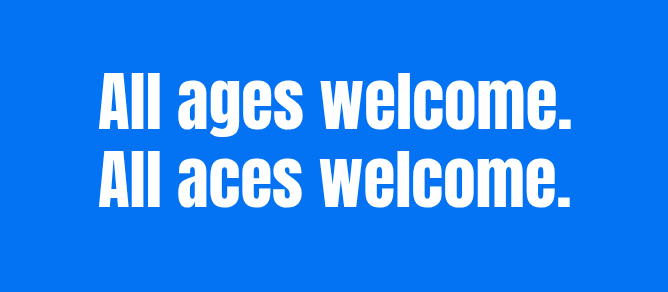
    Screenshot from the header section of a website. Blue background with copywriting that says "All ages welcome. All aces welcome."

    This header introduced the different groups USTA has available within its organization. They wanted to emphasize the fun that is a part of tennis — it’s a game, after all! Using repetition (and a quick tennis pun) allowed me to emphasize that tennis is for everyone.

    Rule: No sentence fragments

    Break it: For rhythm and punch

    Complete sentences are great. Necessary, even. But sometimes, fragments do a better job. They add energy. Emphasis. Impact. Instead of a long, winding sentence, a well-placed fragment forces a pause, making the reader take in each thought. One. Beat. At. A. Time. Used intentionally, they can create urgency, emotion, or a conversational feel that full sentences just can’t match.

    Try it out: Taglines and calls to action (CTAs)

    Taglines and calls to action need to be sharp, direct, and memorable. Fragments help strip away unnecessary words and get straight to the point.

    Example:

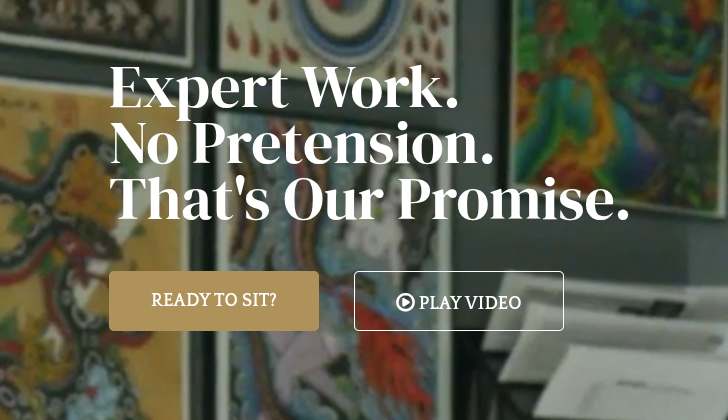
    Classic13 Tattoo wanted a site that showed they were professional and approachable, which isn’t the vibe with all tattoo shops. The sentence fragments, “Expert Work. No Pretension.” balances confidence with intrigue. For the call-to-action, “Ready to sit?” is another fragment that is informal, direct, and speaks to their audience in a way that feels natural and engaging.

    Screenshot from the hero section of a website. "Expert Work. No Pretension. That's Our Promise." in bold text. Two clickable buttons below, one says "Ready to Sit?" and the other "Play Video." Background is a photo with wall art from the tattoo shop.

    Rule: Don’t start sentences with a conjunction

    Break it: For a relatable tone

    Starting sentences with a conjunction like “or,” “and,” or “but” will probably make your old English teacher cringe. But it’s okay. Starting with a conjunction can make your writing more conversational and approachable. Using conjunctions this way mimics the way people speak in real life, helping your copy feel both authentic and engaging.

    Try it out: Blogs and social media posts

    When you start a sentence with a conjunction, it immediately feels less formal. It’s a great tool to use on platforms that already lend themselves to informality — like social media and blogs.

    Rule: Avoid passive voice

    Break it: To emphasize results

    The passive voice often gets a bad rap for being weak or unclear. For the most part, that’s true. This is a copywriting rule to break sparingly and careful. But when done correctly, it can be incredibly effective. Using passive voice is helpful when the focus should be on the result rather than the doer. It can add weight and importance to your message.

    Try it out: Testimonials and case studies

    Testimonials and case studies can be a great spot for passive voice because they highlight results and outcomes — what was achieved rather than who achieved it.

    Rule: Avoid clichés

    Break it: To build familiarity

    Clichés are clichés for a reason — they’re instantly recognizable and universally understood. Sometimes, using a familiar phrase can help your audience connect with your message faster because they already know what it means. When used intentionally, clichés can create a sense of relatability, making your copy feel approachable and grounded.

    Try it out: Taglines and social media

    In places where you need to grab attention quickly or convey a feeling without over-explaining, clichés can do the heavy lifting. These well-worn phrases carry a lot of meaning in just a few words, allowing you to communicate complex ideas or emotions efficiently.

    Example:

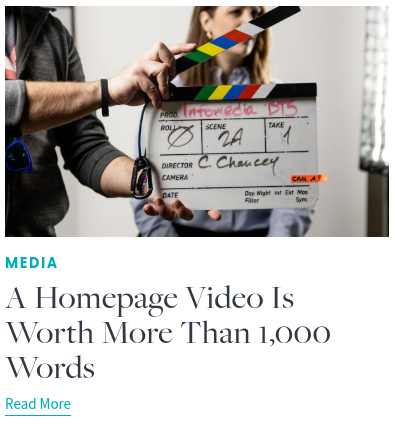
    I took a well-known cliché and gave it a fresh, relevant twist for a blog post. It immediately grabs attention through that recognized cliché, “a picture is worth a thousand words,” while telling you exactly what the blog is about — homepage videos.

    Rule: Never end with a preposition

    Break it: For an authentic tone

    Sometimes, ending a sentence with a preposition isn’t just okay — it’s the best choice. Why? Because that’s how people actually speak. Think about the most common prepositions: at, for, by, to, of. These are incredibly important words that provide context in the English language. If you try to force them into rigid grammar rules, your writing may feel unnatural, robotic, or overly formal.

    Try it out: Scripts and conversational copy

    Most business owners aren’t actors. It’s already so hard for the average person to do a read-to-camera video without sounded like a robot. There’s something about the blinking red light that just makes your spine snap straight and your voice go monotone. If you write your script to sound like a real human speaking, then that’s one less barrier for the talent to overcome for a great video.

    Example:

    I love bad VHS horror movies from the 80s and 90s. I can’t tell you how many times I’ve laughed over an actor who is obviously reading directly from a script. Yes, a lot of it is bad acting. But bad scriptwriting is just as much to blame.

    Rule: Never split infinitives

    Break it: For readability

    The old-school rule about never splitting infinitives (like putting a word between to and a verb) is more about tradition than practicality. In modern writing, splitting an infinitive often makes your copy clearer, more natural, and easier to read. Sometimes, forcing an unsplit infinitive creates awkward phrasing that distracts the reader instead of engaging them.

    Try it out: CTAs and conversational copy

    “My goal is to clearly show your audience what you do.” instead of
    “My goal is to show your audience what you do clearly.”

    Which one sounds better? The first one, of course. Splitting the infinitive keeps the focus on the action (show) and makes the sentence smoother and easier to read. In copywriting, readability always wins over grammar rules. If breaking a rule makes things easier for your audience to understand, then it’s worth doing.

    Break Copywriting Rules — With Intention

    It’s a universal childhood experience to fear the red pen. But we’re not in school anymore, and chances are that your high-school English teacher isn’t your target audience. (Sorry, Mrs. Keeton.)

    The best copy doesn’t just follow a grammar book; it connects, engages, and feels natural to the reader. So go ahead — start that sentence with “and,” repeat yourself for emphasis, or split an infinitive if it makes your message stronger. Just make sure you’re doing it with purpose.

  • Website Mistakes You Don’t Know You’re Making | Part 1

    Website Mistakes You Don’t Know You’re Making | Part 1

    Your website has a lot of jobs — it needs to attract visitors, engage them, build trust, and ultimately drive action. But if it’s not working efficiently, you could miss out on valuable opportunities. The tricky part? Many common website mistakes are easy to overlook.

    The good news? A few simple tweaks can make a big difference. Let’s break down some of the most common website mistakes and how to fix them.

    Dead Ends

    Think about the pages that are a must-see for your customers. These are the pages that drive home your message and tell your audience exactly what you want them to know. This list will be different for every business. But a few that might come to mind are your service/product pages, portfolio pages, or even your about page.

    In a perfect world, your customer gets to that page — exactly where you want them. Now what? Take a look at those pages. Is there a way for them to quickly get from THAT page to the one where they can take action? Odds are the answer is no. This is what’s called a dead end.

    The Solution?

    Get creative! Consider ways to naturally direct your audience back to a desired action. You could add a video to your contact confirmation page that tells them more about your business or your process. You could (and should) add a sitewide CTA that lives at the bottom of every page, right above your footer, that directs users to the main action you want them to take. One of my favorite ways to fix a dead end is a fun 404 page that shows your brand’s personality and suggests your most commonly visited pages.

    Even something as simple as adding a “Back to Projects” button to the bottom of a portfolio page can help create a better experience and keep users on your site longer.

    Hero Sections

    Your hero section is the big banner at the top of your homepage. It’s the first thing your users will see when visiting your website. Think: above the fold. You need to immediately capture your audience and tell them:

    • Who you are,
    • What you do,
    • Why they should choose you, and
    • How they can get started

    But too often, businesses use buzzwords in their hero section instead of clearly telling their audience what they do. This common website mistakes can cost you big-time by confusing your audience.

    “If you confuse, you lose.” — Donald Miller, Building a StoryBrand

    The Solution?

    I usually recommend you avoid getting too cute or clever in the hero section. You don’t want your audience to have to think too hard to figure out what you do. BUT, that doesn’t mean your hero has to be (or should be) boring. Your hero section is a good place to start incorporating your brand voice in a creative and compelling way.

    Hero image from USTA's website. Copy in the header says "Tennis is gooooood for you."

    CTA Buttons

    This one is (almost) entirely selfish. One of my biggest pet peeves on a website is a CTA button that is a complete sentence. “Find out how our team can help you.” That’s not button copy — plain and simple. But so many people still do it! “Shorter CTA, four words max” is probably the most common feedback I give my team of freelancers. CTA buttons need to be short, snappy, simple. Get Started. Let’s Talk. View Our Projects.

    On the flip side, there’s nothing worse than the dreaded “Learn More.” Boring, uninspired, lazy.

    The Solution?

    Always, always, always use simple, specific verbs, like “Get a Website Audit” or make what you’re requesting sound valuable, “Connect With a Copywriter.” 

    Another idea is to test out first person, which makes the button part of your user’s internal dialogue. (Define My Brand Voice instead of Define Your Brand Voice.) I’ve not had as much luck with this one, but it can help you stand out since it’s not used as often.

    Wilty Wilt Test (Or WYLTIWLT)

    While I didn’t create this test, it is easy for me to remember since it has my last name (Wilt) in it. 

    When writing button copy, ask yourself:

    Would you like to [button text]? Meaning “Would you like to [get a website audit]?”

    I would like to [button text]. – Meaning “I would like to [connect with a copywriter].”

    Sitemaps

    “I want to stand out.” – every client I’ve ever met with

    Yes, it’s important to stand out in your industry. No one wants to blend in with their competitors as just another company that does XYZ. But your sitemap is NOT (I repeat: NOT) the place to get cutesy and creative. There are plenty of ways to stand out on your website — messaging, photography, videos, branding. But your sitemap is meant to quickly and easily tell your audience exactly where to find what they’re looking for. No one will spend time digging for the information they need, meaning you’ll stand out for all the wrong reasons. 

    Aside from user experience, web crawlers like Google heavily rely on your sitemap to determine what you do. If your sitemap says something silly like “Hungry?” instead of “Menu,” then Google won’t know what to do with that. 

    The Solution?

    This is one of the few times I’ll tell you to be boring and stick to simple language — About, Team, Services, Careers, Contact. Brand Voice is important, but your sitemap isn’t the place to apply it.

    What’s Next?

    A great website isn’t just about looking good — it’s about working efficiently to guide visitors toward action. If your pages leave users stranded, your CTAs blend into the background, or your navigation makes people think too hard, you’re making their experience more complicated than it needs to be. Small changes, like creating clear next steps, simplifying button copy, and keeping your sitemap intuitive, can make a big difference in how well your site performs. Fixing these website mistakes isn’t just about aesthetics; it helps you build trust, encourage engagement, and generate leads. And this is just the beginning — there’s still more to cover, so stay tuned for part two!